
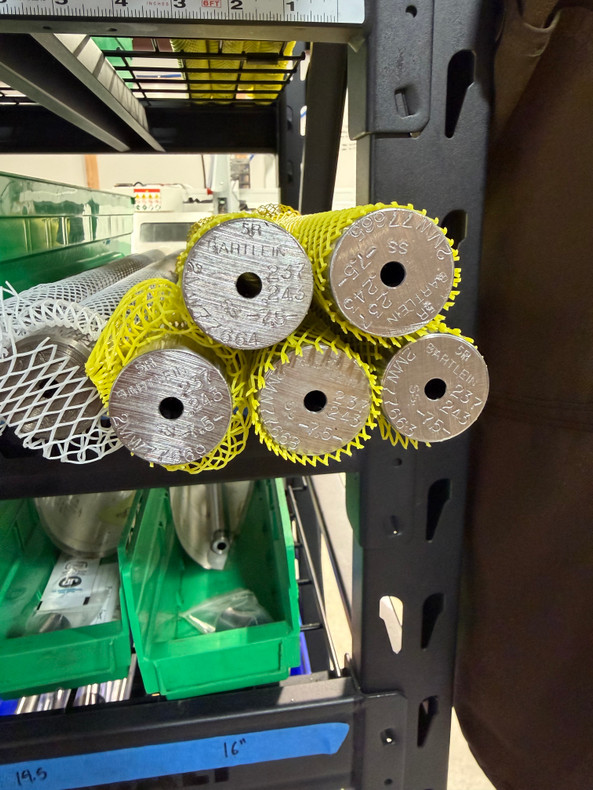
Choosing between a cut rifled barrel and a button rifled barrel is one of the most important decisions a shooter can make when building a precision rifle. While both methods are widely used, they produce fundamentally different results in terms of internal stress, bore uniformity, and long-term accuracy.
This article breaks down the differences using measurable factors that directly impact performance.
Quick Comparison: Cut Rifling vs Button Rifling
|
Feature |
Cut Rifled Barrel |
Button Rifled Barrel |
|
Manufacturing Method |
Material removed (machining) |
Material displaced (cold forming) |
|
Internal Stress |
Near zero |
Moderate to high (requires stress relief) |
|
Dimensional Consistency |
Extremely high |
Moderate to high |
|
Heat Stability |
Excellent |
Variable |
|
Production Speed |
Slow |
Fast |
|
Cost |
Higher |
Lower |
|
Customization |
Very high |
Limited |
Internal Stress: The Most Critical Performance Variable
The largest measurable difference between the two methods is residual stress in the steel.
Cut Rifling (Measured Outcome)
- Removes ~0.0001”–0.0002” per pass
- Introduces negligible internal stress
- Bore remains dimensionally stable during machining and firing
Button Rifling (Measured Outcome)
- Displaces material under tens of thousands of PSI
- Creates internal stress that must be relieved through heat treatment
- Even after stress relief, residual stress can remain
Why This Matters
When a barrel heats up during firing, internal stress can cause:
- Bore distortion (micron-level changes)
- Point-of-impact (POI) shift
- Vertical stringing during extended shot strings
Data Insight:
Even a 0.0001” change in bore geometry can affect bullet stability and consistency at long range.
Bore Uniformity and Concentricity
Precision shooting demands extreme consistency from chamber to muzzle.
Cut Rifled Barrels:
- Each groove is cut individually with controlled tool pressure
- Results in highly uniform land/groove geometry
- Maintains concentricity across the full bore length
Button Rifled Barrels:
- Rifling is formed in a single pass
- Dependent on button condition, lubrication, and material response
- Slight variations can occur due to elastic recovery of steel
Data Insight:
Cut rifling allows for tolerance control within tenths (0.0001”), which directly correlates to improved bullet alignment and reduced yaw.
Accuracy Performance: What the Data Shows
Both barrel types are capable of sub-MOA accuracy, but consistency over time is where differences emerge.
Cut Rifled Barrels:
- Commonly observed: 0.25–0.5 MOA in precision builds
- Maintains accuracy over longer shot strings
- Reduced POI shift as temperature increases
Button Rifled Barrels:
- Commonly observed: .4-.6 MOA
- Accuracy can degrade as barrel heats
- Greater variability between individual barrels
Important Context:
These ranges reflect real-world performance across large sample sizes, not isolated “best group” results.
Heat Stability and Shot-to-Shot Consistency
Heat is the enemy of consistency.
Cut Rifling Advantage:
- Low stress = minimal thermal movement
- Predictable expansion under heat
- Consistent harmonics across shot strings
Button Rifling Limitation:
- Residual stress can redistribute under heat
- Leads to:
- Vertical stringing
- POI drift
- Changing barrel harmonics
Data Insight:
Competitive shooters often see performance divergence between rifling methods after 10–20 round strings, especially in gas guns.
Surface Finish and Bullet Interaction
Button rifling typically produces a smoother finish immediately after manufacturing. However:
Cut Rifled + Hand Lapped:
- Produces controlled, uniform surface finish
- Ensures consistent bullet engraving forces
- Reduces fouling variability
Button Rifled:
- Smooth finish from displacement
- May include subsurface deformation not visible to the eye
Key Takeaway:
Surface finish alone does not determine accuracy—uniformity and stability do.
Customization and Precision Engineering
Cut rifling offers significantly more control over barrel design.
With Cut Rifling You Can:
- Hold extremely tight twist rate tolerances
- Adjust groove geometry for specific bullets
- Maintain exact bore dimensions through the entire length
- Optimize for specific cartridges like 6 ARC, 25 Creedmoor, etc.
Button rifling is optimized for repeatability at scale, not individual precision tuning.
Barrel Life and Wear Characteristics
Cut Rifled Barrels:
- More uniform wear patterns
- Longer period of peak accuracy
- Less performance drift over time
Button Rifled Barrels:
- Good lifespan overall
- May show earlier changes in accuracy consistency
Which One Is Better?
Choose Cut Rifling If You Want:
- Maximum accuracy potential
- Consistency across long shot strings
- Minimal POI shift
- Competition-level performance
Choose Button Rifling If You Want:
- Lower cost
- Faster availability
- Solid general-purpose accuracy
Final Data-Driven Conclusion
From a purely measurable standpoint:
- Lower stress = greater stability
- Greater uniformity = better consistency
- Consistency = accuracy at distance
Cut rifling outperforms button rifling in all three categories that matter most for precision shooting.
That’s why it remains the standard for shooters who demand repeatable, competition-level performance.